How Much Should I Feed My Dog? The Complete Portion Guide (2026)
Quick Answer
- The right amount depends on your dog's weight, age, activity level, and food type — not a single generic number on the bag.
- Use the RER formula (30 × body weight in kg + 70) as a starting point, then adjust with life-stage and activity multipliers to get your dog's Maintenance Energy Requirement (MER).
- Body condition scoring on the WSAVA 1-9 scale is the most reliable way to verify whether your portions are correct.
- Feeding charts on food bags overestimate needs by 15-25% and serve only as regulatory starting points.
Not sure where to start? Find your situation below:
| If your dog has... | Go to this section |
|---|---|
| No idea how many calories they need | The Science of Dog Calorie Needs |
| A body condition you can't assess | Body Condition Scoring |
| A puppy, senior, or giant breed | Feeding Charts by Life Stage and Breed Size |
| A mix of wet, dry, and fresh food | The Food Type Factor |
| A very active or spayed/neutered dog | Adjusting for Activity, Spay/Neuter, and Health Conditions |
| Been overfeeding without realizing it | Common Feeding Mistakes That Cause Weight Gain |
Your dog stands at the pantry door at 5 p.m. tail wagging, while you stare at the food bag wondering whether to measure out one cup, one and a half cups, or just eyeball it like you've been doing for years. You know the feeding chart on the bag is supposed to be your guide, but you've also heard that spayed dogs need less food, that working dogs need more, and that your Labrador might be one of those breeds that gains weight just by looking at a biscuit. The conflicting advice is exhausting.
The Association for Pet Obesity Prevention (APOP) reports that 59 percent of dogs in the United States are overweight or obese, putting them at increased risk for joint disease, heart problems, diabetes, and shortened lifespan. Overfeeding is the most common nutritional mistake dog owners make, and the feeding chart on your dog's food bag was never designed for individual dogs — it's a regulatory minimum, not a prescription. This article gives you the formulas, the body condition scoring method, and the life-stage tables to feed your dog with confidence. Also see our guides on fresh dog food vs kibble, puppy nutrition guide, and senior dog nutrition.

The Feeding Confusion — Why Your Dog's Food Bag Isn't Giving You the Full Picture
The feeding chart on your dog's food bag is a regulatory starting point, not a personalized feeding plan — and relying on it alone is one of the most common reasons dogs become overweight.
The Association of American Feed Control Officials (AAFCO) requires pet food manufacturers to include feeding instructions on labels, but these charts serve as minimum guidelines for a hypothetical moderately active, intact adult dog. They do not account for your dog's specific metabolic rate, whether they have been spayed or neutered, their current body condition, or the calorie density of the specific formula you purchased. A 2019 study from the Tufts University Veterinary Nutrition Service found that generic feeding directions frequently overestimate how much to feed a dog by 15 to 25 percent, particularly for small breeds and less active dogs.
The calorie density of dog food varies significantly between brands and formulas — ranging from roughly 300 kcal per cup for some budget kibbles to over 450 kcal per cup for high-protein, grain-free formulas. This means that one cup of Brand A might contain as many calories as one and a half cups of Brand B, and the bag's chart has no way of telling you which one you are holding.
Common Mistake: Treating the food bag's feeding chart as your dog's personalized prescription. The chart assumes average activity and does not account for your dog's individual metabolic rate, spay/neuter status, or body condition. Calculate from RER and MER instead.
Key Takeaways
- Feeding charts are regulatory minimums, not individualized prescriptions
- Calorie density varies widely between brands — cup amounts are not transferable
- The bag's chart is a starting point, never the final answer
The Science of Dog Calorie Needs — RER, MER, and the Formulas That Actually Work
The Resting Energy Requirement (RER) is the single most important number in canine nutrition — it is the baseline calorie count your dog needs to maintain basic physiological function while at rest.
To calculate your dog's RER, multiply their body weight in kilograms by 30 and add 70. The formula is simple: RER = 30 × (body weight in kg) + 70. This gives you the baseline calories your dog needs at rest. The Maintenance Energy Requirement (MER) then applies life-stage multipliers to the RER to account for daily energy demands. The National Research Council (NRC) established these multipliers in Nutrient Requirements of Dogs and Cats (2006). For adult dogs in maintenance, the multiplier is approximately 1.6 × RER. Puppies in growth need roughly 2 × RER. Senior dogs need approximately 1.4 × RER.
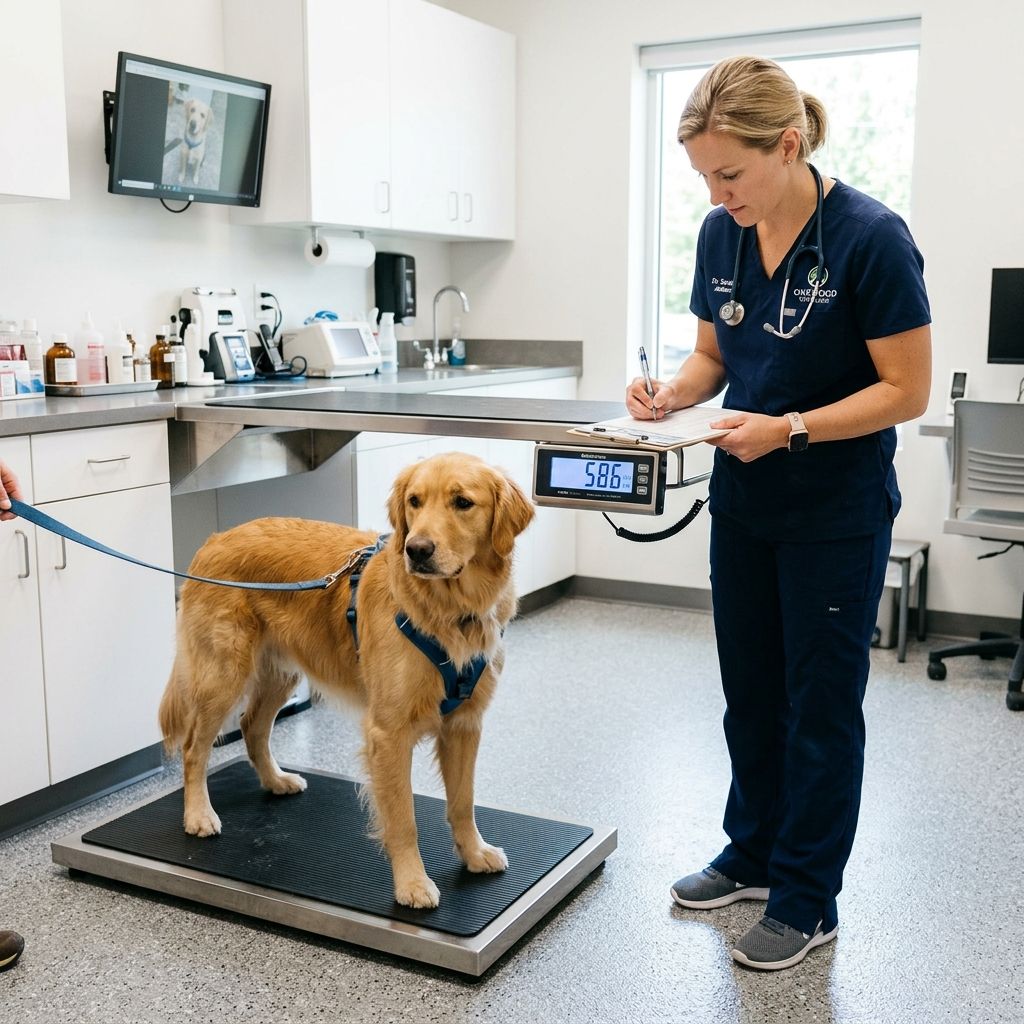
For a practical example, consider a 20 kg (44 lb) adult dog with moderate activity. The RER calculation is 30 × 20 + 70 = 670 kcal per day at rest. Applying the adult maintenance multiplier of 1.6 gives an MER of approximately 1,072 kcal per day. If this dog is spayed or neutered, reduce the multiplier to 1.4 to 1.5 because gonadectomy reduces basal metabolic rate by 15 to 20 percent.
Vet Tip: Weigh your dog in kilograms rather than pounds. The RER formula uses kilograms, and converting from pounds (divide by 2.205) at the start prevents calculation errors later.
Key Takeaways
- RER is the baseline; MER adjusts for life stage, activity, and reproductive status
- The formula 30 × weight (kg) + 70 works for most adult dogs
- Puppies need roughly twice their RER for growth; seniors need 10 to 15 percent less
- Spayed and neutered dogs need 15 to 20 percent fewer calories than intact dogs
Body Condition Scoring — Your Dog's Best Feedback System
The WSAVA Body Condition Score is the most reliable method for determining whether your dog's current portions are producing the right body composition.
The World Small Animal Veterinary Association (WSAVA) developed the 1-9 Body Condition Score (BCS) scale as a standardized clinical tool. A score of 4 to 5 represents ideal body condition. Scores of 1 to 3 indicate underweight, and scores of 6 to 9 indicate progressive overweight to obesity. The assessment involves three steps: visual evaluation from above, palpation of the ribs, and evaluation of the waist and abdominal tuck from the side.
A dog at an ideal BCS of 4 or 5 should have a visible waist behind the ribs that tapers inward slightly when viewed from above. The ribs should be easily felt with minimal fat covering — like feeling the knuckles of your hand when your palm is flat. From the side, you should see a clear abdominal tuck.
Vet Tip: Take a photograph of your dog from above and from the side every two weeks during portion adjustments. Visual progress helps verify if your calorie calculations are working.
Key Takeaways
- BCS 4 to 5 is the target for most dogs — ideal is a visible waist and palpable ribs
- Do not rely on the scale alone; body composition matters more than weight number
- Reassess BCS every two to four weeks when adjusting portions
Feeding Charts by Life Stage and Breed Size
A dog's calorie needs shift dramatically across their lifespan — applying adult maintenance formulas to puppies or seniors is a major calculation error.

| Life Stage | RER Multiplier | Notes |
|---|---|---|
| Puppy (growth) | 2.0 × RER | Adjust every 2-4 weeks as weight increases |
| Puppy (giant breed) | 1.8 × RER | Controlled growth to protect joints |
| Adult (intact, moderate activity) | 1.6 × RER | Standard maintenance |
| Adult (spayed/neutered) | 1.4-1.5 × RER | 15-20% reduction due to lower metabolism |
| Senior (age 7+) | 1.4 × RER | Increased fiber, reduced fat |
| Working/agility dog | 1.8-2.0 × RER | Validate with BCS weekly |
Key Takeaways
- Puppies need 2 × RER for growth; giant breed puppies need a lower multiplier to protect joint health
- Adult dogs at 1.6 × RER need a 5 to 15 percent reduction if spayed or neutered
- Senior dogs need fewer calories but higher fiber — the metabolic rate drops with age
The Food Type Factor — Kibble vs Wet vs Fresh
A cup of kibble is not equivalent to a cup of wet food, and neither is equivalent to a scoop of fresh food — calorie density determines portion size.

Kibble calories range from 300 to 450 kcal per cup depending on formula. Wet food is less calorie-dense by volume: one 13-ounce can of wet food equals roughly two cups of dry kibble in calories, but fat levels vary. Fresh food pouches range from 300 to 500 kcal depending on the recipe.
Key Takeaways
- Cup amounts are not transferable between brands or food types
- Wet food is less calorie-dense per volume than kibble
- Always check the kcal per unit on the label before measuring portions
Adjusting for Activity, Spay/Neuter, and Health Conditions
Real-world adjustments for activity level, reproductive status, and health conditions turn a baseline estimate into a precise plan.
| Factor | Multiplier Adjustment | Notes |
|---|---|---|
| High activity (working, agility) | 1.8-2.0 × MER | Validate weekly with BCS |
| Moderate activity (daily walks) | 1.6 × MER | Standard adult maintenance |
| Low activity (couch potato) | 0.8-1.0 × MER | Watch for rapid weight gain |
| Spayed/neutered | 1.4-1.5 × MER | 15-20% reduction from intact baseline |
Key Takeaways
- Activity level is a multiplier on top of MER — working dogs may need 50% more calories
- Spaying/neutering reduces metabolic rate by 15-20%
- Re-evaluate BCS every two to four weeks to fine-tune portions
Common Feeding Mistakes That Cause Weight Gain

Mistake 1: Following the bag's chart without adjustment. Feeding charts overestimate needs by 15-25%. Calculate from RER and MER instead.
Mistake 2: Free-feeding dry kibble. Leaving food out removes portion control. Feed two scheduled meals per day.
Mistake 3: Not counting treats and extras. Keep treats under 10% of daily calories and subtract treat calories from meal portions.
Mistake 4: Relying only on the scale. Assess BCS every two to four weeks to measure actual body composition.
Mistake 5: Keeping the same cup amount when switching foods. Different foods have different caloric densities — recalculate portions on day one of transition.
Frequently Asked Questions
How much food should I feed my dog by weight?
Start with the RER formula: 30 × body weight in kg + 70. Then multiply by the life-stage factor (1.6 for adults, 2.0 for puppies, 1.4 for seniors). Divide total MER calories by the kcal per cup on your dog's food label.
What is body condition score in dogs?
The WSAVA Body Condition Score is a 1-9 scale where 4 to 5 is ideal. It uses visual waist evaluation, rib palpation, and abdominal tuck to determine if your dog's portion size is correct.
Do spayed dogs need less food?
Yes. Spayed and neutered dogs have a 15 to 20 percent lower metabolic rate and require a reduced multiplier (1.4-1.5 × RER) to prevent weight gain.
Should I feed my dog once or twice a day?
Most adult dogs do best with two meals per day for portion control and glycemic stability. Puppies under 6 months need 3 to 4 smaller meals daily.
What are the signs of overfeeding a dog?
Signs include an invisible waist from above, difficulty feeling ribs without pressing firmly, absent abdominal tuck, lethargy, and gradual weight gain. Reduce portions by 5 to 10 percent if noticed.
How much should a senior dog eat?
Senior dogs (age 7+) need approximately 1.4 × RER with increased fiber and reduced fat to account for lower activity and metabolic slowdown.
How do I convert wet food portions to kibble equivalents?
Divide the kcal per can of wet food into the kcal per cup of kibble and adjust the volume accordingly based on your dog's total daily MER calories.
Key Takeaways
- The feeding chart on your dog's food bag is a starting point, not a prescription — calculate from RER and MER instead.
- RER = 30 × body weight in kg + 70; MER applies life-stage and activity multipliers.
- Body condition scoring on the WSAVA 1-9 scale is the most reliable way to verify portions.
- Portion sizes change with food type, calorie density, life stage, and activity level.
- Treats must stay under 10 percent of daily calories.
- Reassess your dog's BCS every two to four weeks and adjust portions by 5 to 10 percent.
References
- National Research Council. Nutrient Requirements of Dogs and Cats. National Academies Press; 2006.
- Association for Pet Obesity Prevention (APOP). 2022 State of Pet Obesity Report. APOP; 2022.
- World Small Animal Veterinary Association (WSAVA). Body Condition Score for Dogs. WSAVA Guidelines; 2020.
- Tufts University Veterinary Nutrition Service. Accuracy of Pet Food Feeding Directions. Tufts; 2019.
- Clinicians Brief. The Relationship Between Gonadectomy and Obesity Risk in Dogs: A Review. Clinicians Brief; 2020.
- Association of American Feed Control Officials (AAFCO). Pet Food Report 2015 Annual. AAFCO; 2015.
- U.S. Food and Drug Administration (FDA). Investigation: Potential Link Between Certain Diets and Canine Dilated Cardiomyopathy (DCM). FDA; 2019.
- Oba PM, et al. Apparent total tract nutrient digestibility and metabolizable energy estimation in commercial fresh and extruded dry kibble dog foods. J Anim Sci. 2021.
- Journal of the American Veterinary Medical Association (JAVMA). Once-Daily Feeding Is Associated with Lower Cognitive Dysfunction Scores in Adult Dogs. JAVMA. 2022.
- American Animal Hospital Association (AAHA). Nutrition and Weight Management Guidelines. AAHA; 2024.